

Kidney Cancer Incidence
You may be told you have kidney or renal (relating to the kidneys) cancer. However, not all kidney cancers are the same, and there are different types. The largest subtype is renal cell carcinomas (RCC). Below are 8 different types of RCCs;
Conventional or clear cell RCC – this can also be called non-papillary RCC and accounts for 70 – 80% of RCC cases [1]
● Papillary or chromophilic RCC accounts for 5-10% of RCC cases [1]
● Chromophobe RCC accounts for about 3-5% of cases [1]
● Collecting duct carcinoma
● Renal medullary carcinoma
● Mucinous tubular and spindle-cell carcinoma
● Unclassified renal cell carcinoma, the latter five of which together make up the remaining 5-10% of RCC tumours.
You may also be told you have urothelial (or translocational [TCC]), which may be in your renal pelvis or ureter and may require you to have a nephrectomy. However, any further treatment would follow the bladder cancer pathway due to the cell type that has become cancerous.
The incidence of kidney cancer is higher in men, meaning that men are more likely to get kidney cancer. It accounts for 4% of all new cases of cancer diagnosed in men (2017-2019), and just over 2% of all cancers in women (2017-2019) in the UK [2]. Making it the 6th most common cancer, with around 8,800 new cases in 2017-2019 and in UK women it ranked 10th most common cancer, with around 5,100 new cases between 2017-2019 [2].
Kidney cancer is therefore a relatively rare cancer; however, some reports have indicated an increasing incidence globally, including in the UK. This increase could in part be due to the wider application of diagnostic imaging techniques, leading to the incidental detection of asymptomatic kidney tumours. Changes in lifestyles have increased certain risk factors, such as smoking and obesity, which may have also contributed to the increase in incidence.
Incidence of kidney cancer in the UK
Between 2017-2019, kidney cancer was the 6th most common cancer in adults in the UK. There were around 13,900 new cases of kidney cancer in the UK between 2017-2019, that’s around 38 cases diagnosed every day [2]. There were 5,100 kidney cancer deaths in the UK in 2021-2023, that’s around 14 deaths every day; this accounts for about 3% of all cancer deaths in the UK and makes kidney cancer the 11th most common cause of cancer deaths [3].
It has been estimated that the lifetime risk of developing kidney cancer for those born in 1961 is 1 in 38 men and 1 in 68 women will be diagnosed with kidney cancer during their lifetime [4].
The number of new cases and rates for kidney cancer in the UK as a whole, and for its devolved nations between 2017-2019 are shown in Table 1. The crude incidence rate (the number of kidney cancer cases divided by the population and multiplied by 100,000) shows there are about 27 new kidney cancer cases for every 100,000 males per year in the UK, and 15 cases for every 100,000 females per year.
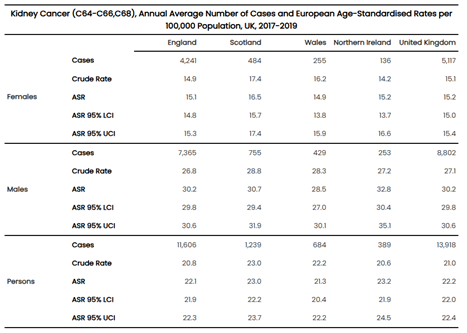
The crude incidence rate doesn’t take into account the age of the population, and since cancer generally affects older people, the crude incidence rate is greatly affected by the proportion of older people in the population. The European age-standardised rates are adjusted to take into account the number of old or young people in the population. European age-standardised rates do not differ significantly between UK devolved nations for either sex [2].
Kidney cancer is rare in young adults and children, but rates begin to rise after the age of 40. About three-quarters of people diagnosed with kidney cancer (75%) are over 60 years old and the highest rates are in the 70-74 age range for both men and women. In the UK in 2017-2019, on average each year around a third of new cases (34%) were in people aged 75 and over. Rates of kidney cancer are increasing in all age groups within the UK [5].
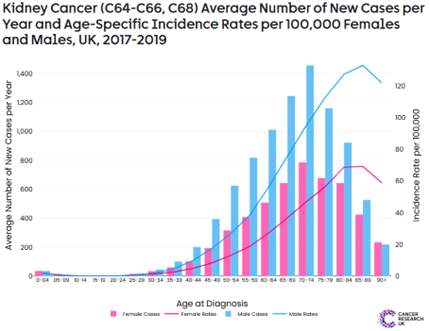
Table 1. www.cancerresearchuk.org
Kidney cancer rarely affects children, and about 45-50 paediatric cases are diagnosed in the UK each year. About 75% of childhood kidney cancer occurs in the under-fives. The most common paediatric kidney cancer is Wilm’s tumour. Others include hereditary kidney cancer syndromes, such as von Hippel-Lindau disease (see Childhood Kidney Cancer fact sheet for more information).[1.1]
For kidney cancer, like most cancer types, incidence increases with age. This largely reflects cell DNA damage accumulating over time. As we age our cells naturally become damaged, as well as other factors which may increase damage to cells and therefore your chances of developing cancer. They are;
● Tobacco smoke [7]
● Some substances in food[7]
● Chemicals in our environment[7]
● High energy (ionising) radiation, such as x-rays[7]
Age-specific incidence rates rise from around 35 to 39 years of age, steadily for females and more steeply for males. The highest rates occur in the 80 to 89 age group for females and males.
Kidney cancer rates are significantly lower in females than males in a number of (mainly older) age groups. The only age group where there are more women than men with kidney cancer is the 90+, this could be due to women living longer than men.
Areas of deprivation and incidence of kidney cancer
The government in England refers to deprivation as;
“Deprivation refers to people’s unmet needs, a lack of access to opportunities and resources which we might expect in our society.” [8]
Within the UK around 1,100 cases of kidney cancer can be linked with deprivation, this equates to approximately 580 females and 510 males. It has been found that kidney cancer incidence is 40% higher in females and 17% higher for males within the most deprived areas when compared with the least deprived areas during 2013-2017 [1].
Kidney cancer and ethnicity
In England (2013-2017) it has been found that incidence rates of kidney cancer are lower within Asian and Black ethnic groups, and also in people with multiple ethnicities when compared with the white ethnic group [1].
Global incidence of kidney cancer
Kidney cancer is the 14th most common cancer worldwide. It is the 9th most common cancer in men and the 14th most common cancer in womenThere were more than 430,000 new cases of kidney cancer globally in 2020, by 2022, this had risen to 434 840. Incidence and mortality rates are highest in Asia, possibly due to the increased population. However, looking at all cases (new and existing), the highest proportion of the population living with kidney cancer occurs in Europe. Globally kidney cancer remains more prevalent in males than females. [6].
References
[1] https://www.cancerresearchuk.org/about-cancer/kidney-cancer/stages-types-grades/types-grades#renal-cell-cancer [Accessed Feb 2026]
[2]https://crukcancerintelligence.shinyapps.io/CancerStatsDataHub/_w_29b33b98e3ce458d802acca71f49d101/?_inputs_&nav=%22Incidence%20Breakdowns%20and%20Trends%22&app_select_CancerSite=%22Kidney%22&app_select_Country=%22United%20Kingdom%22 [Accessed Feb 2026]
[3]https://crukcancerintelligence.shinyapps.io/CancerStatsDataHub/_w_56fea532567a4d15a89471b1e8b41e1e/_w_380dfd1ce4194aaab6416244e1349dcb/?_inputs_&nav=%22Mortality%20Breakdowns%20and%20Trends%22&app_select_CancerSite=%22Kidney%22&app_select_Country=%22United%20Kingdom%22 [Accessed Feb 2026]
[4] https://www.cancerresearchuk.org/health-professional/cancer-statistics/statistics-by-cancer-type/kidney-cancer/risk-factors [Accessed Feb 2026]
[5]https://crukcancerintelligence.shinyapps.io/CancerStatsDataHub/_w_509140d79f94479eaaba82eb2acefcb5/?_inputs_&nav=%22Incidence%20Breakdowns%20and%20Trends%22&app_select_CancerSite=%22Kidney%22&app_select_Country=%22United%20Kingdom%22 [Accessed Feb 2026]
[6] https://gco.iarc.who.int/media/globocan/factsheets/cancers/29-kidney-fact-sheet.pdf [Accessed Feb 2026]
[7] https://www.cancerresearchuk.org/about-cancer/what-is-cancer/genes-dna-and-cancer [Accessed March 2026]
[8] https://deprivation.communities.gov.uk/ [Accessed March 2026]
Cancer Research UK [